The PROCYSBI Benefit

12-HOUR DOSING SCHEDULE FOR CONTINUOUS CYSTINE CONTROL

Discover the advantages of a 12-hour dosing schedule with

PROCYSBI. Adherence to cysteamine therapy is crucial to cystinosis

management.1-3

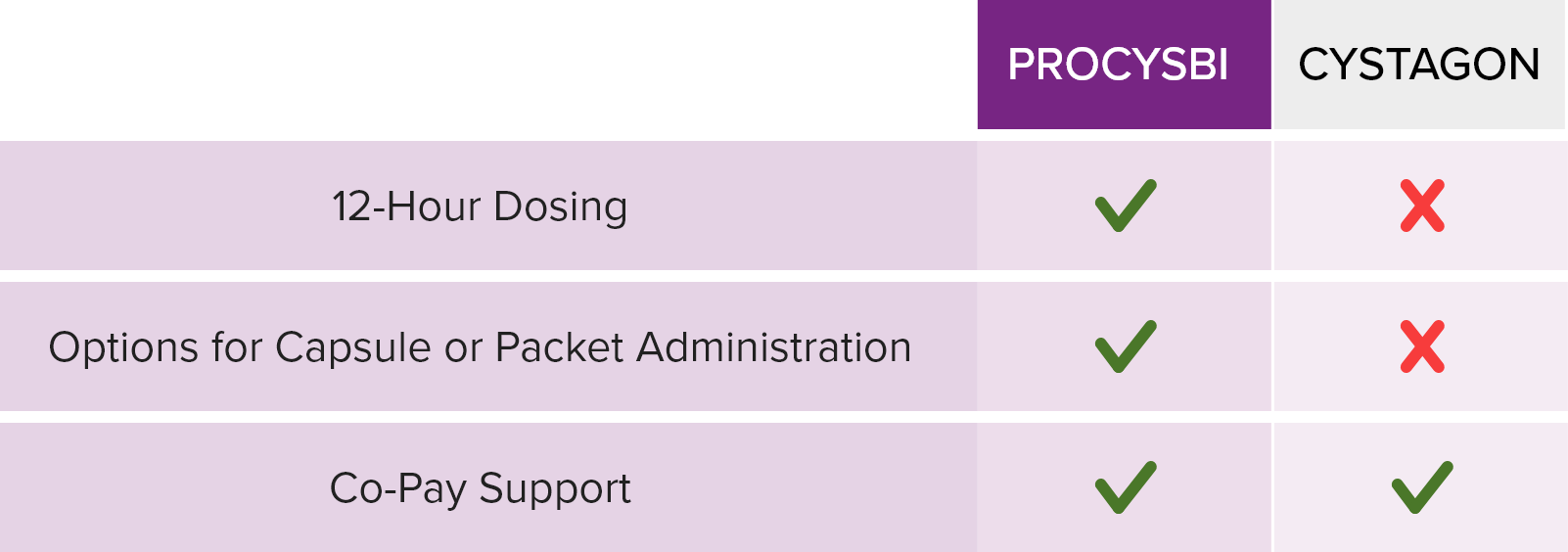
PROCYSBI has a twice-daily dosing schedule. With 12 hours between doses, your patients may reduce interruptions in their sleep, which may increase adherence.4

PROCYSBI vs CYSTAGON

With PROCYSBI, you can offer your patients a medicine that similar efficacy of CYSTAGON and significantly improves patients’ experience with a 12-hour dosing schedule and options for capsules or granules.4

Join the growing community of healthcare providers who trust PROCYSBI to deliver optimal efficacy with minimal disruptions.
Why Choose PROCYSBI for Your Patients?

  • Capsules are available in 25 mg and 75 mg strengths.

  • Patients who prefer to swallow whole capsules may be good candidates for PROCYSBI in capsules.

  • Packets are available in 75 mg and 300 mg strengths.

  • Patients who may be good candidates for PROCYSBI in packets include those who

    - Take their medicine via a gastrostomy tube (G-tube)
    - Have difficulty swallowing capsules
    - Prefer to open capsules over swallowing them

Group 74611

Extended 12-Hour Dosing: Sleep disruptions can be reduced with a simplified dosing schedule4

Group 74613

Support and Resources: Review our comprehensive tools to assist healthcare professionals in helping your patients get access to PROCYSBI

*A retrospective study analyzing cystine and cysteamine levels with use of immediate release vs delayed release cysteamine in 17 patients with nephropathic cystinosis.

Group 75323
Determine correct dosing for your patient
Group 75331
Have more questions?

Stay informed about PROCYSBI and cystinosis

References

1. Gahl WA, Balog JZ, Kleta R. Nephropathic cystinosis in adults: natural history and effects of oral cysteamine therapy. Ann Intern Med. 2007;147(4):242-250. 2. Elmonem MA, Veys KR, Soliman NA, van Dyck M, van den Heuvel LP, Levtchenko E. Cystinosis: a review. Orphanet J Rare Dis. 2016;11:47. 3. Nesterova G, Gahl WA. Cystinosis: the evolution of a treatable disease. Pediatr Nephrol. 2013;28(1):51-59. 4. van Stein C, Klank S, Grüneberg M, et al. A comparison of immediate release and delayed release cysteamine in 17 patients with nephropathic cystinosis. Orphanet J Rare Dis. 2021;16(1):387.

INDICATION and IMPORTANT SAFETY INFORMATION

INDICATION

PROCYSBI (cysteamine bitartrate) delayed-release capsules and delayed-release oral granules is a cystine-depleting agent indicated for the treatment of nephropathic cystinosis in adults and pediatric patients 1 year of age and older.

IMPORTANT SAFETY INFORMATION

CONTRAINDICATIONS

  • Patients with serious hypersensitivity reaction, including anaphylaxis to penicillamine or cysteamine.

WARNINGS AND PRECAUTIONS

  • Ehlers-Danlos-like Syndrome: Skin and bone lesions that resemble clinical findings for Ehlers-Danlos-like syndrome have been reported in patients treated with high doses of immediate-release cysteamine bitartrate or other cysteamine salts. Monitor patients for development of skin or bone lesions and reduce PROCYSBI dosing if patients develop these lesions.
  • Skin Rash: Severe skin rashes such as erythema multiforme bullosa or toxic epidermal necrolysis have been reported in patients receiving immediate-release cysteamine bitartrate. Discontinue use if severe skin rash occurs.
  • Gastrointestinal (GI) Ulcers and Bleeding: GI ulceration and bleeding have been reported in patients receiving immediate-release cysteamine bitartrate. Monitor for GI symptoms and consider decreasing the dose if severe symptoms occur.
  • Fibrosing Colonopathy: Fibrosing colonopathy has been reported with postmarketing use of PROCYSBI. Evaluate patients with severe, persistent, and/or worsening abdominal symptoms for fibrosing colonopathy. If the diagnosis is confirmed, permanently discontinue PROCYSBI and switch to immediate-release cysteamine bitartrate capsules.
  • Central Nervous System (CNS) Symptoms: CNS symptoms such as seizures, lethargy, somnolence, depression, and encephalopathy have been associated with immediate-release cysteamine. Monitor for CNS symptoms; interrupt or reduce the dose for severe symptoms or those that persist or progress.
  • Leukopenia and/or Elevated Alkaline Phosphatase Levels: Cysteamine has been associated with reversible leukopenia and elevated alkaline phosphatase levels. Monitor white blood cell counts and alkaline phosphatase levels; decrease or discontinue the dose until values revert to normal.
  • Benign lntracranial Hypertension: Benign intracranial hypertension (pseudotumor cerebri; PTC) and/or papilledema has been reported in patients receiving immediate-release cysteamine bitartrate treatment. Monitor for signs and symptoms of PTC; interrupt or reduce the dose for signs/symptoms that persist, or discontinue if diagnosis is confirmed.

ADVERSE REACTIONS

The most common adverse reactions reported in PROCYSBI clinical trials (≥ 5%): were:

  • Patients 2 years of age and older previously treated with cysteamine: vomiting, nausea, abdominal pain, headache, conjunctivitis, influenza, gastroenteritis, nasopharyngitis, dehydration, ear infection, upper respiratory tract infection, fatigue, arthralgia, cough, and pain in extremity.
  • Patients 1 year of age and older naïve to cysteamine treatment: vomiting, gastroenteritis/viral gastroenteritis, diarrhea, breath odor, nausea, electrolyte imbalance, headache.

DRUG INTERACTIONS

  • Drugs that increase gastric pH may alter the pharmacokinetics of cysteamine due to the premature release of cysteamine from PROCYSBI and increase WBC cystine concentration. Monitor WBC cystine concentration with concomitant use.
  • Consumption of alcohol with PROCYSBI may increase the rate of cysteamine release and/or adversely alter the pharmacokinetic properties, as well as the effectiveness and safety of PROCYSBI.
  • PROCYSBI can be administered with electrolyte (except bicarbonate) and mineral replacements necessary for management of Fanconi Syndrome as well as vitamin D and thyroid hormone.

USE IN SPECIFIC POPULATIONS

  • Lactation: Because of the potential risk for serious adverse reactions in breastfed children from cysteamine, breastfeeding is not recommended during treatment with PROCYSBI.

Please see Full Prescribing Information.